Table Of Content

Domain-driven design (less often, domain-driven design, DDD) is a set of principles and schemes aimed at creating optimal systems of objects. The development process boils down to creating software abstractions called domain models. These models include business logic that links the actual conditions of a product’s application to the code.
Deconstructing Monoliths with Domain-driven Design - InfoQ.com
Deconstructing Monoliths with Domain-driven Design.
Posted: Sun, 10 Jun 2018 07:00:00 GMT [source]
How to reuse React components across your projects
The models and the naming of their attributes will not only be used in conversations but also directly in your code to connect the problem domain with the software. To protect the domain layer, keep it separate from technical concerns. Check out Clean Architecture proposed by Uncle Bob to gain helpful insights on achieving that goal. Domain-driven design (DDD) is an approach to developing software for complex needs by deeply connecting the implementation to an evolving model of the core business concepts. Software engineers recognize from the late 1960s that procedural languages are inadequate in handling the growing complexity of software projects.
Aggregate
It emphasizes close collaboration between domain experts and developers to create software that accurately models the problem domain. By focusing on the domain’s core concepts, relationships, and behavior, DDD enables the creation of more robust, flexible, and maintainable systems. At the heart of this was the idea that to develop software for a complex domain, we need to build Ubiquitous Language that embeds domain terminology into the software systems that we build. While many folks talked about developing such models, they were often only done on paper, and usually expected to be done up-front.
Understanding Domain-Driven Design (DDD)
While Generic Subdomains focus on solving generic problems faced by most products, Supporting Subdomains focus on solving problems that are specific to your product and support the Core Subdomains. DDD is all about reducing complexity — dividing and conquering the problem. It requires you to split up the complex domain/problem into smaller subdomains/subproblems that are more manageable.

Bounded Contexts
This is where your business rules define the way data gets created, stored, and modified. The domain-driven approach is here to solve the complexity of software development. On the other hand, you can use emergent design when the challenge is simple. However, when your application is complex, the complexity will only grow, and so will your problems. To organize the boundaries between different domains a context map can be used to display responsibilities and dependencies on a higher level. A context map includes not only the models with their attributes but also events that are shared between domains grouped by domain.
It’s the part that leads the user from one to another UI screen. It can perform simple validation but it contains no domain-related logic or data access. Its purpose is to organize and delegate domain objects to do their job. Moreover, it’s the only layer accessible to other bounded contexts. Domain-Driven Design (DDD) provides a powerful framework for building complex software systems that are aligned with the business domain. By incorporating DDD principles, such as bounded contexts, context mapping, and the strategic and tactical patterns, developers can create scalable, adaptable, and maintainable systems.
Domain-Driven Design and Micro Frontends: Organizing Autonomous Teams for Collaborative Success
A report published by InfoQ shows DDD in Late Majority stage of technology adoption. This stage implies that more than half the software folks have adopted DDD and the skeptics are starting to adopt them too. In the upcoming articles in this series, we'll delve deeper into each of these concepts, providing real-world examples and practical advice on how to apply them effectively in your projects. Event sourcing is an architectural pattern in which entities track their internal state not by means of direct serialization or object-relational mapping, but by reading and committing events to an event store.
The Importance of Patterns in DDD - InfoQ.com
The Importance of Patterns in DDD.
Posted: Tue, 28 Feb 2017 08:00:00 GMT [source]
We don't want these infrastructrual things to sully our clean, fast, and testable domain model. Value Objects are simple objects that convey meaning and functionality. These objects describe things but don’t have a special identity. Before diving into concepts, here is a small example of how Domain-Driven code looks. I encourage you to go back to it after reading the rest of the article.
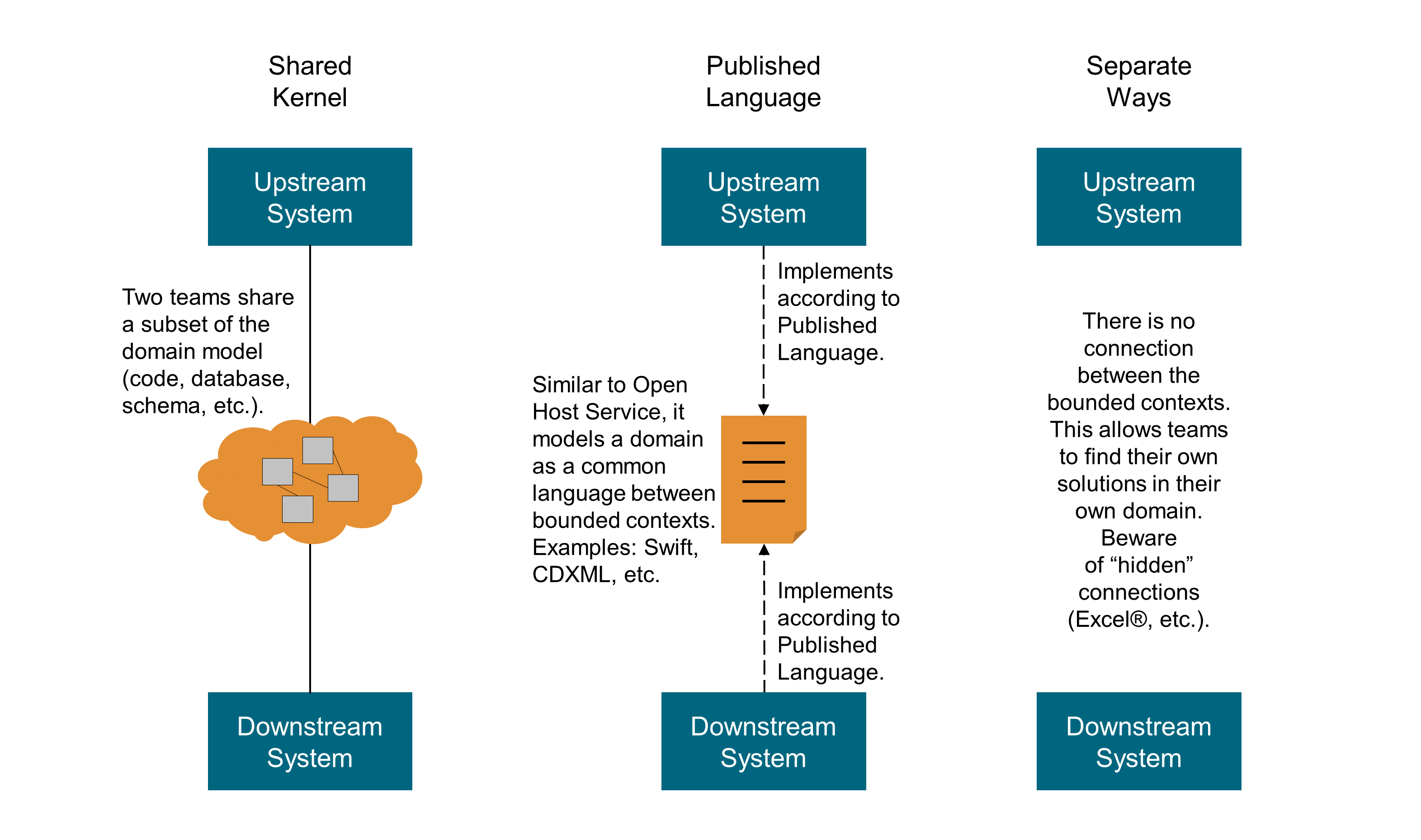
In the context of Domain-Driven Design, the focus is on designing the software in a way that accurately reflects the structure and behavior of the domain. It's not unusual for an application to span several different domains. So instead DDD divides up a large system into Bounded Contexts, each of which can have a unified model - essentially a way of structuring MultipleCanonicalModels. The emphasis of Domain Driven Design is to understand the problem domain in order to create an abstract model of the problem domain which can then be implemented in a particular set of technologies. On the other hand, value objects don’t have unique identifiers.
During the development process, sales and warehouse were identified as two of the core domains of that software. But what you should build with perfection is the Core Subdomains of your business since it will be the heart of the product you’re creating. Some of these design factors are technological, and a great deal of effort has gone into the design of networks, databases, and other technical dimension of software.
DDD helps discover the top-level architecture and inform about the mechanics and dynamics of the domain that the software needs to replicate. Concretely, it means that a well done DDD analysis minimizes misunderstandings between domain experts and software architects, and it reduces the subsequent number of expensive requests for change. Modeling aggregate roots to output events can isolate internal state even further than when projecting read-data from entities, as in standard n-tier data-passing architectures. One significant benefit is that axiomatic theorem provers (e.g. Microsoft Contracts and CHESS[8]) are easier to apply, as the aggregate root comprehensively hides its internal state.
An application is decomposed into loosely coupled services, each being self-contained and managing its own data. From the perspective of DDD, a microservice maps to a subdomain and bounded context. These resources teach and show how software development practitioners and domain experts can work together to model business domains.


No comments:
Post a Comment